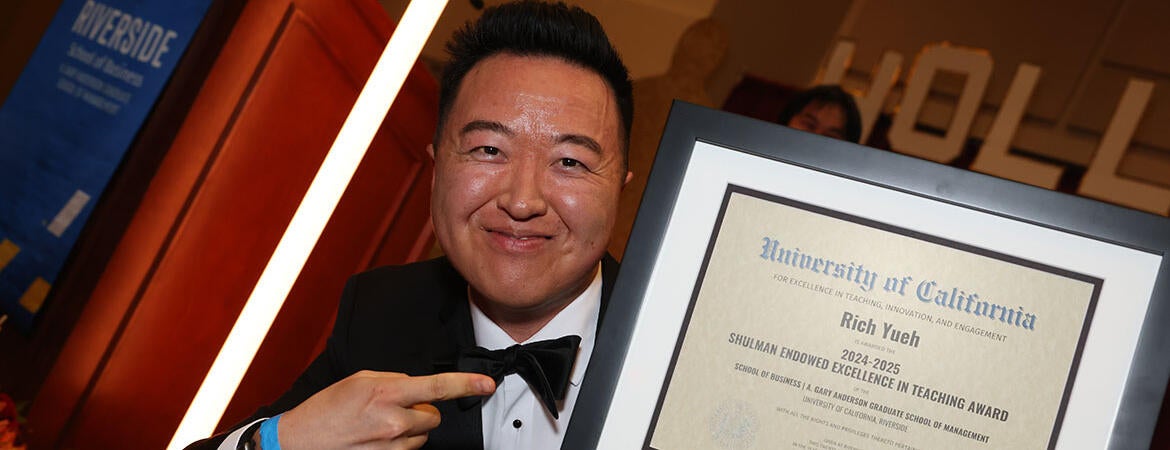
Students describe Dr. Rich Yueh as “a dream professor: intelligent, fun, and compassionate.” They say that he “goes above and beyond to ensure the course material is applicable to the real world.”
Those qualities earned the assistant professor of teaching in information systems the student-voted 2025 Shulman Endowed Excellence in Teaching Award.
Yueh has long been an early adopter of technology. He was one of the first instructors at UCR to bring generative AI into the classroom. But he’s quick to emphasize that technology alone isn’t the point.
“My focus isn’t just on adapting to a changing world,” he said, “but on how we can be more human within it.”
In a world where AI can deliver content, Yueh believes what remains distinctly human is the capacity to think for yourself. That’s why he approaches teaching not as a transfer of information, but as a process of helping students develop their own judgment. He said he feels he has done his best work as a teacher when he becomes less necessary, when students begin to rely on their own capacity to think.
'Pull everything out of your students'
To explain that philosophy, Yueh points to a poster in his office listing the “Ten Rules for Students and Teachers,” developed in the 1960s by artist, activist, and educator Corita Kent. Originally intended for art students, the rules have grown to inspire other creative fields, including teaching, Yueh said.
One of the rules that stands out for him is No. 3 — "General duties of a teacher: pull everything out of your students.”
“That’s the whole thing. My job isn’t to fill them up. It’s to create the space and rhythm where what’s already inside can come forward,” he said.
A lifelong teacher
Teaching, Yueh realized early on, has been a consistent thread throughout his life. He partly credits good luck and good timing for becoming a professor at UCR, but he also points to a clear element of intentionality.
As a child, he helped his immigrant parents learn colloquial English. In high school, he worked as an after-school math and reading tutor. During his PhD program, his department chair recognized his aptitude for teaching and assigned him multiple courses to lead before he graduated.
“When I was approaching the job market, I looked back and thought, ‘I’ve been teaching my whole life,’” Yueh said. “’Let’s make this into something I can really do well.’ That’s how I found my way into this role.”
Making learning approachable
In the classroom, Yueh focuses on making the learning process feel approachable without lowering expectations. Students arrive with different backgrounds and levels of confidence, he said, and his goal is to design courses that meet them where they are academically. That approach is especially important for transfer students and first-generation students, who may encounter unfamiliar expectations in a large university setting.
“I start by understanding their assumptions and experiences,” he said. “Then I build the class from that foundation.”
In information systems courses, that means helping students see technical concepts through familiar business contexts, particularly when the material initially feels intimidating.
“If you’ve ever used a basic function in Excel — even something as simple as SUM — you’ve already written instructions for a computer,” he said. “If you’ve ever calculated profit or loss as the difference between revenue and costs, you’ve used logic. It’s about helping students see that technology isn’t separate from how they already think about business.”
Learning beyond the classroom
Yueh also serves as a faculty advisor for student organizations, including those focused on product management and UI/UX. In that role, he helps students apply classroom concepts to real-world projects and professional development opportunities.
Yueh said he learns as much from the students as they learn from him. “They still learn from me— how to run an organization, how to network,” he said. “But they’re also at the forefront, running workshops and reaching out to professionals. They and our alumni are the first line of feedback on what’s happening in the industry.”
It’s a practical extension of the philosophy he describes in the classroom: creating conditions where students’ ideas and initiative can surface.
Recognition for teaching excellence
The Shulman Endowed Excellence in Teaching Award is the latest in a series of student-voted recognitions Yueh has earned. In the School of Business, these include three Golden Apple awards — two in 2022 alone, the same year he received the inaugural James Merino Innovation Award. In 2023, he received campus-wide recognition with the Academy of Distinguished Teaching Innovative Teaching Award.
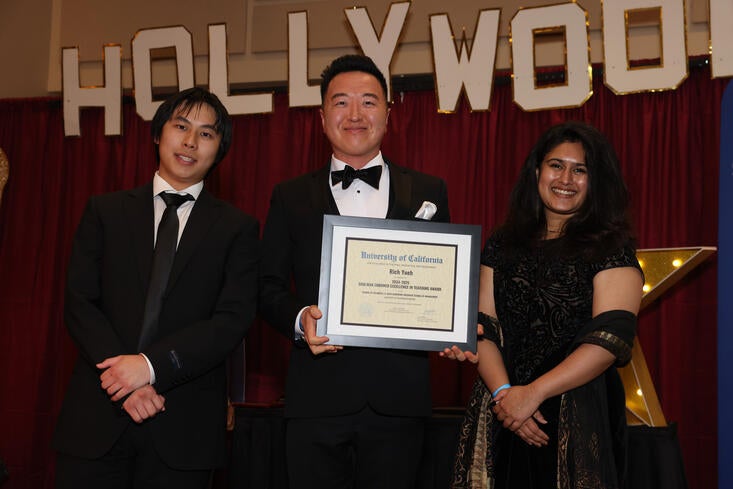
Established to honor exemplary teaching that awakens curiosity, encourages creativity, and fosters an open and engaging learning environment, the Shulman Award reflects many of the values that guide Yueh’s work in the classroom. For him, the award carries both meaning and motivation, but the measure that matters most is simpler: “If a student leaves my class more confident in their own ideas than mine, that’s a good quarter.”