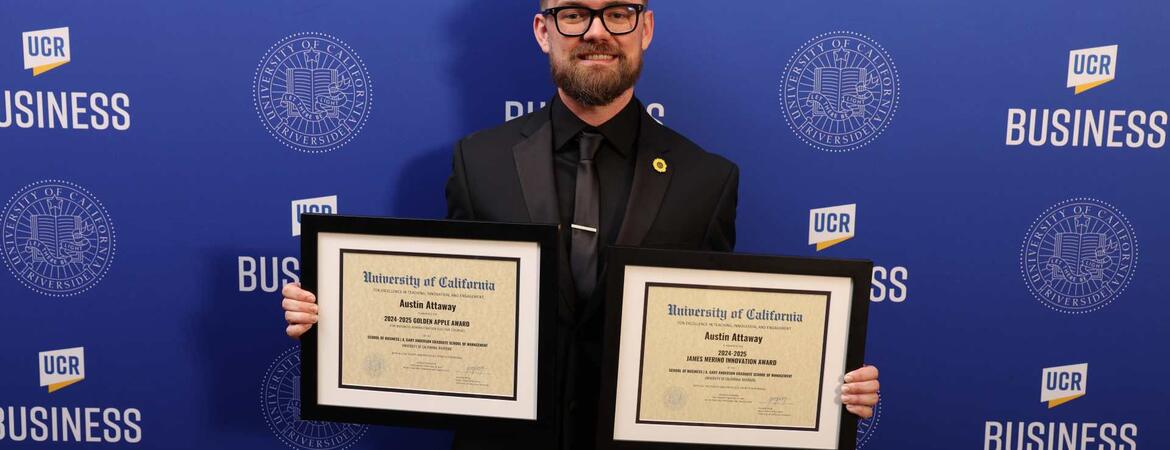
Lecturer in Management Austin Attaway classes on business, ethics and psychology regularly fill 300-seat auditoriums.
But that’s not the reason he doesn’t take roll. It’s because he doesn’t believe attendance is a useful measure of learning.
“If you can pass the class without being here, more power to you,” he said.
“This isn't high school. We are adults here,” Attaway said, noting he also doesn’t assign anything he would consider “busy work.”
“A lot of my teaching philosophy is rooted in self-determination theory, which is the idea of autonomy and being challenged at just the right amount,” he said. “Busy work isn't challenging.”
That respect for students — and his ability to engage their attention — can be seen in the student comments supporting Attaway’s selection in 2025 for two faculty awards: the Golden Apple Award for Teaching Excellence in Undergraduate Elective Courses, and the James Merino Innovation Award.
‘The best teacher ever’
In voting for the Golden Apple recognition, one student wrote that Attaway is “the best teacher ever — he actually made me WANT to go to class.”
The Merino award, which recognizes a faculty member for bringing innovative ways of teaching or utilizing innovative tools and technologies in the classroom, drew similar praise. Students wrote that Attaway’s class “has been one of the best experiences I’ve had in the program. His teaching style made the material interesting and meaningful.” Another wrote, “he created a safe space and proactive means of engagement.”
The awards were gratifying for Attaway, as someone who is just starting his second year of teaching at UCR.
“I didn’t even know about these awards until some of my students mentioned them,” he said. “So it's an absolute honor and privilege to win two. It really shows that I’m connecting with the students and that I’m doing something right.”
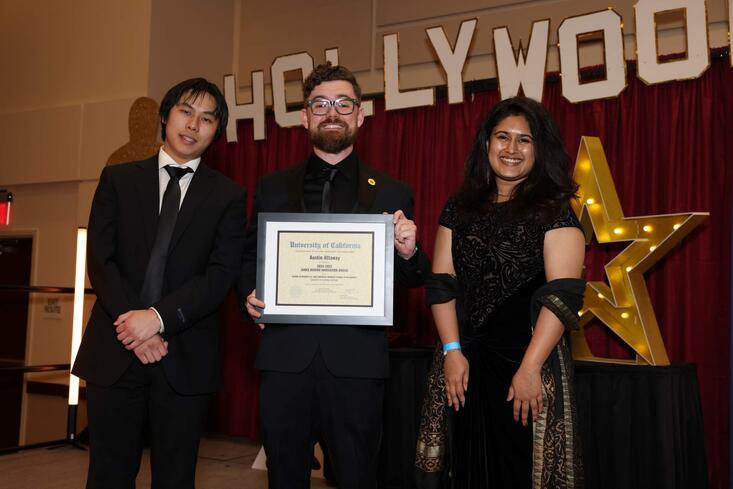
That doesn’t mean he plans to rest on those laurels. Attaway views the awards as incentives to continue innovating in the classroom, staying connected with students and keeping them energized about learning.
“A big piece for me is to make sure that, even though I'm just at the beginning of my journey, to not dip into complacency,” he said. “I want to continue to innovate, meet my students where they are, not get complacent, not get frustrated. I want to kind of evolve these methods and maintain the excitement around the creativity that I can bring to every class every year.”
A natural fit
That commitment to the class experience comes naturally to Attaway. But he didn’t initially plan to pursue a career in education.
His undergraduate degree — earned at UCR — is in psychology. While serving as CEO of Life Source Affordable Counseling in Riverside, he earned his master’s degree in organizational behavior and evaluation at Claremont Graduate University. Then, while pursuing his doctorate in organizational behavior at Claremont, he started teaching.
Attaway discovered that the skills he uses as a corporate consultant — applying principles of industrial-organizational psychology — were a good fit for the classroom.
“Working with C-suite executives translated really well to helping students learn really difficult concepts very quickly,” he said. “That is what really started to make me kind of fall in love with teaching.”
The connection to UCR also was a good fit, and not just because of his undergraduate experience: His counseling practice is only seven minutes away from campus. When an opportunity came up to teach an ethics class, he jumped at it.
Encouragement and engagement
Since winning the faculty awards, Attaway has been reflecting on why his approach creates a connection with students.
He starts by helping students overcome any intimidation about speaking up in class. He gets things started with simple questions. Once someone sees their ideas validated and redirected toward the main topic, “a bunch of hands go up after that.”
Attaway is disciplined in his lectures, limiting himself to no more than 15 slides in a presentation, even for a three-hour class. He also believes his age — he just turned 30 — helps him relate real-life concepts in a meaningful way to students.
“The types of classes I teach, business and psychology, are more human and theory-oriented,” he said. “A lot of these topics are things we have probably experienced in some way or another in our day-to-day lives. So, drawing on the students’ experiences makes it immediately relevant to them.”
As for the innovation recognized by the Merino Award, Attaway thinks that speaks more about the culture he builds in the classroom than any technology.
“First, I make the classroom a safe and comfortable space, and I keep the energy high,” he said. “I am an educator, but proper education comes from holding their attention.”
His assignments are diversified into three categories, generally described as tests, papers, and presentations. This accommodates different strengths to find the appropriate score for passing, he said.
“Some students are good test takers, some of them are good presenters,” he said. “So we triangulate that score on the content around three different approaches, depending on the type of course.”
One of his more innovative practices was the gamification of exams, he said. To design this, he has drawn on his experience as an undergraduate, when he earned sponsorships and competed professionally playing Pokemon in regional and world championships.
Attaway also designs board games in his free time, although at first glance that free time might be in short supply.
‘Authentic service’
In addition to leading Life Source Affordable Counseling and teaching at UCR, Attaway teaches at UC Irvine and services as the Chair of the HR Board for the City of Riverside. He's also writing a book on the theory of "bounded rationality," the idea that people are not 100% rational— a concept he explored during a TED Talk a couple of years ago.
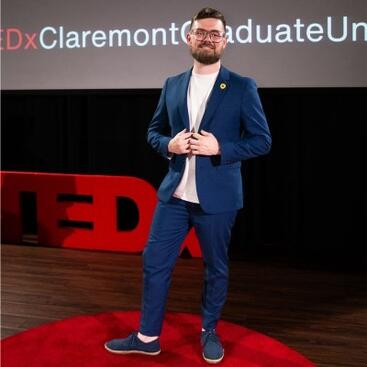
As of this year, he has launched a nonprofit podcast exploring the Psychology of various topics from our everyday lives and promoting mental health awareness. His podcast, Ego/Id: The Psychology of Everything, can be found at www.egoid.org. You can also follow it on Instagram at @ego.over.id or Attaway himself @Dr.Attaway.
“I think a piece of misinformation that a lot of people have around work-life balance is that it's some sort of 50-50 split, but it looks very different for everybody,” he said. “For some people it's 80-20. For some people it's three or four different things they have to balance. Some would say I'm a workaholic, but I would argue that I get a lot of value and purpose from my work.”
It all comes down to what Attaway describes as an emphasis on “authentic service” — something that applies to his counseling clinic as well as his classroom. That helps explain why it’s not good enough just to show up to be counted in attendance.
“Nobody needs to be perfect, but if you care and you want to give some value, then show up and bring your all,” he said. “It’s not about just showing up. It’s about doing your best.”