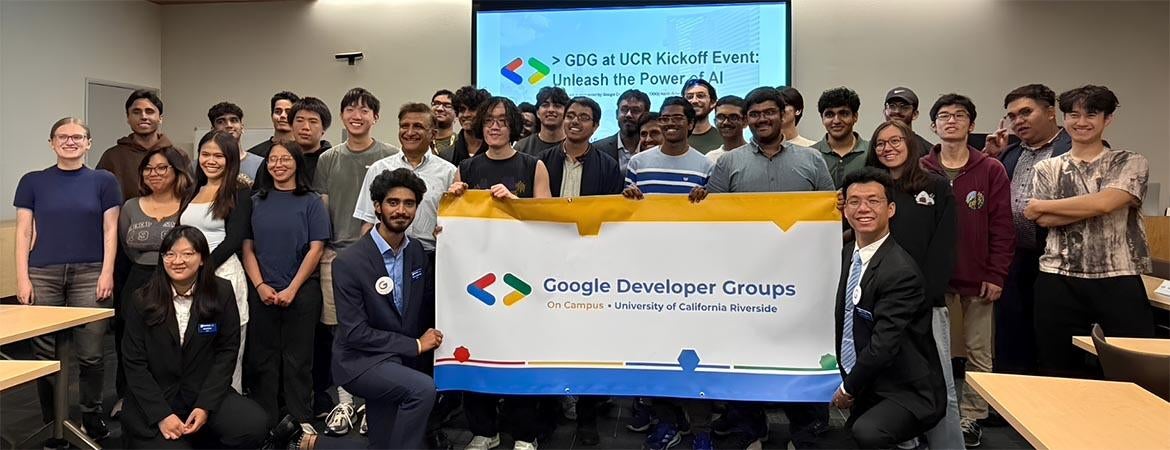
UC Riverside’s Google Developer Group (GDG) student chapter began with a simple conversation that quickly grew into a much larger vision for campus.
“The idea of starting a GDG chapter at UCR came from seeing how impactful these groups were at other universities and believing UCR students deserved the same kind of opportunity. When Sandeep also became interested, we began working together to turn it into a real campus initiative,” says Yung-Sian Fang ’27 PMBA.
“What stood out to me most was the reaction from our board members and students when we explained the vision,” adds Sandeep Lakkireddy ’25, ’27 MBA. “You could genuinely see the excitement in the room. That was the moment it felt real, like this was something students had been waiting for.”
What started as an idea shared during an A. Gary Anderson Graduate School of Management Student Association event at the end of October 2025 soon became a real initiative focused on creating a space where students could explore technology, build practical skills, and connect with a broader community of innovators. When they shared the idea with Associate Professor of Marketing Ashish Sood, he was impressed by the vision for the organization and excited about its potential. He offered to support the chapter and serve as a mentor. Over the next several months, the team worked through the official registration process with Google Developer Groups while also completing the required campus paperwork and coordination with UC Riverside. By the end of March 2026, all the necessary steps were completed, and GDG at UCR officially became an established student organization.
Official Kickoff
“What is most impressive is their momentum,” says Sood. “Within just one week of formal approval, the team organized a kickoff event that drew nearly 50 attendees. “This wasn’t just a social mixer. Students were already engaging with advance topics, like retrieval-augmented generation—known as RAG—and the Google Solution challenge, which tasks teams with building prototypes for real-world problems.” The strong turnout made it clear that there was real interest among UCR students in having a community centered around technology, innovation, and hands-on learning. During the kickoff, students were introduced to the purpose of GDG at UCR; learned about current topics in AI, such as Retrieval-Augmented Generation (RAG); and participated firsthand in a demo using Google resources. The event also introduced the Google Solution Challenge to students not previously familiar with it.
Opportunity for Everyone to Learn By Doing
“At its core, GDG at UCR is focused on creating opportunities for students to learn by doing,” says Lakkireddy. The club plans to host technical workshops, coding sessions, AI build events, speaker sessions with Google developer experts and other industry professionals, and collaborations with different GDG chapters. And, he says, these experiences, are designed not only to help students strengthen their technical knowledge, but also to expose them to emerging technologies, everyday applications, and collaborative problem-solving. “Rather than simply teaching through slides, the goal is to create an environment where students actively engage with ideas, tools, and projects in a practical and approachable way,” adds Lakkireddy.
A Network Beyond Campus
Google supports groups like the UCR GDG chapter through the broader Google Developer Groups ecosystem. Student organizers receive access to a global network, guidance, learning resources, event support, and opportunities to connect with the Google developer experts and other professionals, as well as to collaborate with other GDG communities at different universities and across regions. The team is looking to collaborate with these other university GDG chapters, including the possibility of hosting an international virtual event with a chapter in Turkey, according to Lakkireddy.
Open To All Students—Coders and Noncoders
“One of the most important things about UCR’S GDG chapter is that it is not just for students who already know how to code. The club is open to all students, regardless of major, background, or experience level,” says Fang. “For noncoding students, the club is an opportunity to engage with innovation, product thinking, teamwork, design, and technology applications in a way that feels approachable,” Fang says. “Students can come in with curiosity, build confidence over time, and collaborate with others in a supportive campus community.” The group is scheduled to host its next featured workshop, “Build with AI: From Image to Business Insight with Gemini,” on Thursday, May 28. This beginner-friendly session will demonstrate how Gemini translates unstructured visual data into actionable business insights, offering immediate value for students across marketing, operations, and consulting fields.
Learning Leadership
Fang and Lakkireddy think of the chapter as a chance to serve as a bridge between technical learning and student engagement, which is especially valuable for careers in product development, innovation, consulting, entrepreneurship, and other leadership-focused paths, according to Fang. “Being part of GDG at UCR will influence both our career goals with experience that extends beyond the classroom,” says Fang. “In addition to strengthening our understanding of technology and innovation, the chapter is helping Sammy and me develop leadership, communication, collaboration, and community-building skills through direct interaction with students, professionals, and other GDG chapters around the world.”
_______________________________
Header image: UCR GDG including student leaders, members, and faculty advisor Associate Prof. Ashish Sood